
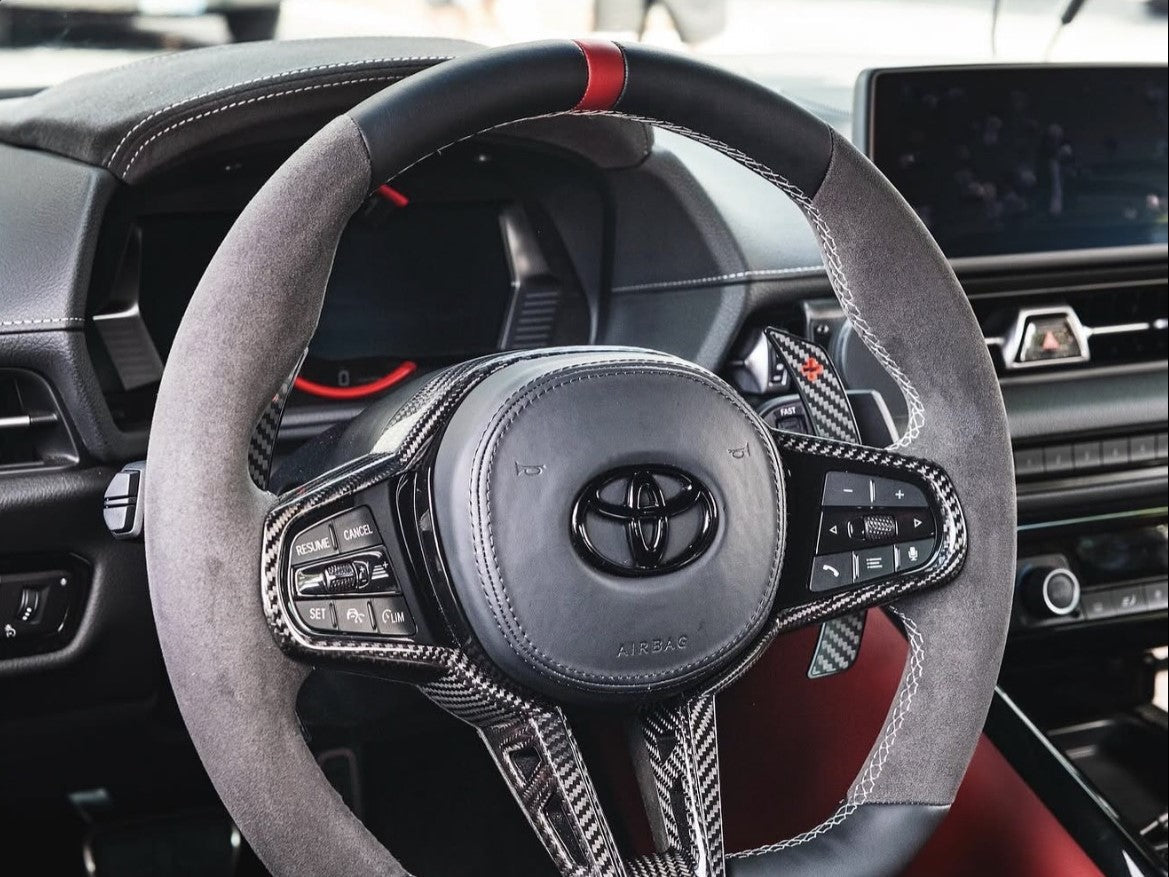
An aftermarket steering wheel is one of the best-value interior upgrades you can make. It's the one thing you touch every single time you drive. But it's also a modification that trips a lot of people up, because the legality comes down almost entirely to one thing: your airbag.
Get that part right and you're fine. Get it wrong and you've removed a primary safety device, failed your next inspection, and potentially voided your insurance. Here's how it actually works in Australia.
The short answer
If your car came from the factory with a driver airbag, you have to keep it. A wheel that deletes the airbag, or a quick-release wheel, is not road-legal on an airbag-equipped car. The legal path is a wheel that retains your factory airbag and is compliant for your specific vehicle. Older cars that never had an airbag have more freedom, but still have rules to meet.
The one question that decides everything: did your car come with a driver airbag?
Just about every passenger car built from the mid-1990s onward has a driver airbag in the steering wheel, and that single fact changes the whole conversation.
Cars with a factory airbag
Passenger cars manufactured from June 1995 have to comply with ADR 69 (full frontal impact occupant protection). For these cars, the steering wheel isn't a free-for-all. The replacement has to be either a wheel certified by the vehicle manufacturer as suitable for your car, or one certified by the wheel maker as complying for your specific make and model.
The hard rule underneath all of that: you cannot remove or disable a factory-fitted airbag. Fitting a non-airbag aftermarket wheel to a car that came with an airbag in the wheel is not acceptable, full stop. South Australia's vehicle standards spell it out plainly, and every other state takes the same position, because the car's crash protection was certified with that airbag in place.
So what can you actually do? Keep the airbag. The cleanest legal route on a modern car is a wheel that reuses your original frame, airbag module and controls, just with new trim. Re-trimmed OEM wheels in leather, Alcantara or carbon are exactly this: they look and feel like a serious upgrade while keeping every safety system the car was signed off with. If you go for a fully aftermarket wheel, it still needs to be compliant and certified for your specific vehicle, so check that before you buy, not after.
Cars without a factory airbag
If your car never had a driver airbag (think older pre-mid-90s stuff), you've got far more freedom, but it's not a blank cheque. The wheel still has to meet the ADR 10 steering requirements:
- No smaller than 330mm in diameter.
- If the original had a recessed or padded hub, the replacement has to be a similar design.
- Firmly padded and built to deform on impact without splintering or cracking into sharp pieces.
- A working horn.
Cars manufactured before 1971 are the most relaxed, where non-standard aftermarket wheels are generally permitted as long as they're safe.
What's never road-legal, regardless of car
- Airbag delete. Removing or disabling a factory airbag to fit a wheel you like is the single biggest no.
- Quick-release and removable hubs. These belong on a race car. They compromise steering security and the steering lock, and they'll fail a roadworthy.
- Anything under 330mm. Tiny race-style wheels don't meet the minimum diameter.
Don't forget the functional stuff
Even a compliant wheel has to keep the car working properly. A proper fitment retains the horn, the clock spring (the coil that keeps the airbag and controls connected as you turn), your cruise, audio and phone buttons, paddle shifters where fitted, the self-cancelling indicators and the steering lock. A cheap adaptor that introduces play in the column or kills half your buttons is both a safety issue and an inspection failure waiting to happen.
It's national rules, state enforcement
The ADRs are national, but each state enforces them through its own roadworthy and defect system, and some require engineering certification for steering modifications. South Australia is explicit that an airbag car can only run a manufacturer-certified wheel. NSW covers it under its light vehicle modification rules. Victoria can require VASS engineering sign-off for significant changes. Before you commit, check your own state's transport authority so you know exactly what's required where you drive.
What happens if you get it wrong
- Defect notice. The yellow sticker, requiring you to put a compliant wheel and airbag back before the car is legal again.
- Fines and failed inspections. A non-compliant wheel can fail a roadworthy or rego check outright.
- Insurance void. This is the big one. Many insurers will refuse a claim if the airbag was removed or an incompatible wheel was fitted, especially if it contributed to an injury. That's a potentially life-changing bill on top of losing the protection itself.
- Increased liability. Driving a car you've knowingly made less safe raises your exposure after a crash.
How to upgrade your wheel the legal way
- Keep your factory airbag. Non-negotiable on any car that came with one.
- Choose a wheel that's compliant for your exact make and model. Re-trimmed OEM wheels that reuse your original frame, airbag and controls are the safest path on a modern car.
- Retain the functions. Horn, clock spring, buttons, paddles, steering lock all need to keep working.
- Get it professionally installed and torqued correctly, and sort any engineering certificate your state requires.
- Leave the quick-release for the track.
The bottom line
Aftermarket steering wheels aren't banned in Australia. The line is your airbag: keep it, fit a wheel that's compliant for your car, and retain the functions, and you're on the right side of the law with a cabin that feels brand new. Delete the airbag or run a quick-release on the road, and you're not.
Browse our steering wheels range to find an option suited to your car, and if you're after the carbon look, our dry carbon vs wet carbon guide explains what you're actually paying for. Not sure whether a wheel keeps your airbag and suits your model? Get in touch with the team and we'll confirm fitment before you buy.
This article is general information, not legal advice. Vehicle standards change and are enforced differently between states and territories. Confirm the requirements for your specific vehicle with your state or territory transport authority or a licensed vehicle certifier before modifying your steering wheel, and never remove a factory-fitted airbag.


