
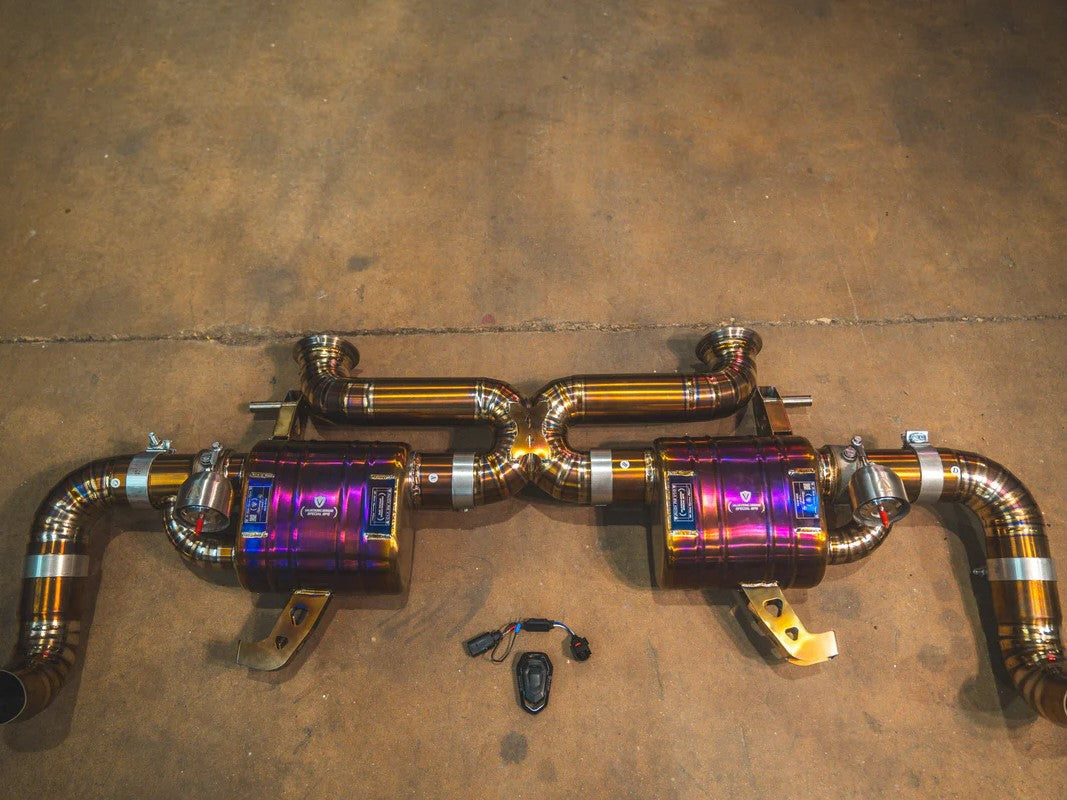
Exhausts are the most popular mod in the game, and also the one that lands the most people with a defect notice. The good news is that plenty of aftermarket exhausts are completely road-legal. The catch is that "legal" comes down to two separate tests, and a lot of the setups people actually want sit on the wrong side of one of them.
Here's how it really works in Australia, minus the forum myths.
The short answer
An aftermarket exhaust is legal if it does two things: stays under your vehicle's noise limit, and keeps the emissions equipment your car was built with. A quality cat-back that keeps your catalytic converter and isn't screaming loud is generally fine. Gut your cat or run it too loud and you're not road-legal, no matter how good it sounds.
Two tests, both have to pass: noise and emissions.
Test 1: Noise
Vehicle noise is governed nationally by ADR 83/00. For a brand-new car, the manufacturer has to pass a drive-by noise test, and the car gets a recorded stationary "signature" noise level unique to that model.
Once your car is on the road, the states enforce noise using the National Stationary Exhaust Noise Test. An officer measures your exhaust with a meter roughly half a metre from the tip, at a set engine RPM, and compares the reading to what your car is allowed.
What you're allowed depends on your vehicle:
- For cars with a compliance date after 1 September 2011, the limit is your vehicle's ADR 83/00 signature noise level.
- For cars before that date, it's the signature level plus 5 dB(A).
As a rough rule of thumb, most passenger cars built after 1983 sit around a 90 dB(A) cap, but the real number is tied to your specific model's signature level, not a flat figure. On top of that, every state has a blanket offence for causing "unnecessary" or excessive noise, so even a technically borderline setup driven obnoxiously can get you pinged.
Test 2: Emissions
This is the one people forget. You cannot modify your car in a way that increases emissions beyond the standard it was built to meet. In practice that means:
- If your car came with a catalytic converter, you can't remove it.
- If it's a diesel with a DPF, that has to stay too.
This is exactly why catless or "decat" setups aren't road-legal, even though they're everywhere. We broke this down in detail in our guide on catted vs catless downpipes, but the short version is: removing the cat removes the emissions control, and that's the line you can't cross on a road car.
So what's actually legal?
Plenty, if you choose the right type of system:
- Cat-back and axle-back systems. These replace everything from the cat backwards, so they never touch your emissions equipment. They change the sound and free up some flow while leaving the cat in place. If you're unsure which suits you, our cat-back vs axle-back guide walks through the difference. This is the safest legal path to a better-sounding car.
- Valved exhausts. A valved exhaust lets you switch between quiet and loud. Worth knowing: a quiet mode doesn't legalise a system that's too loud with the valves open. The system still has to comply, so don't assume "I'll just close the valves for the test" is a free pass.
- High-flow cats. These keep a catalyst in the system rather than deleting it, so they're a step up from a decat. But a high-flow cat doesn't automatically meet the exact emissions standard your car was certified to, so treat them as a grey area rather than a guaranteed legal swap, and check what's accepted in your state.
It's national rules, state enforcement
The ADRs are national, but each state polices exhausts its own way, usually through the EPA and police together:
- NSW: The EPA works with police on noise, and an over-limit car can be issued a defect requiring inspection at an authorised station.
- VIC: The EPA enforces noise and emissions, and significant modifications can require a VASS engineering approval certificate.
- QLD: Roadside stationary noise inspections are common, generally against that ~90 dB(A) benchmark.
- SA: Defective vehicles can be ordered in for inspection before they're road-legal again.
- WA and others: Limits and processes vary slightly, but all track back to the ADRs.
Before you commit to a build, it's worth a quick check of your own state's transport authority or EPA, because what passes in one state can be flagged in another.
What happens if you get caught
- Defect notice. The classic yellow "canary" sticker, requiring you to rectify the exhaust and pass an inspection before the car is legal to drive.
- Fines. Penalties vary by state and by how far over you are.
- Registration trouble. Severe or repeat offences can lead to rego suspension or cancellation.
- Insurance risk. Many policies can void cover if an illegal modification is involved in a claim, which is a much bigger bill than any fine.
The biggest myth
Loud does not automatically mean illegal. A change in your exhaust note is fine as long as you stay under your noise limit and keep your emissions gear. The law isn't "any modification is banned", it's "don't exceed the dB limit and don't delete the cat". That leaves a lot of room for a car that sounds genuinely better and stays legal.
How to stay on the right side of it
- Go cat-back or axle-back rather than decat if road legality matters to you.
- Keep your catalytic converter (or DPF on a diesel) in place.
- Buy reputable brands that supply stationary noise test information and are built to sane noise levels.
- Get it professionally installed and, where your state requires it for the modification, sorted with the right engineering or VASS certificate.
- Keep the paperwork so you can prove compliance if you're ever pulled in for a check.
The bottom line
Aftermarket exhausts aren't banned in Australia. The legal path is a quality cat-back or axle-back that keeps your cat and stays under your car's noise limit. Where people get caught is deleting the cat or chasing maximum volume.
If you want a better sound the right way, browse our exhaust ranges from Valvetronic Designs, Armytrix, Akrapovič, AWE Tuning and Invidia. Not sure what's compliant for your car and state? Get in touch with the team and we'll point you at the right setup.
This article is general information, not legal advice. Noise and emissions rules change and are enforced differently between states and territories. Confirm the requirements for your specific vehicle with your state or territory transport authority or EPA, or a licensed vehicle certifier, before modifying your exhaust.


