
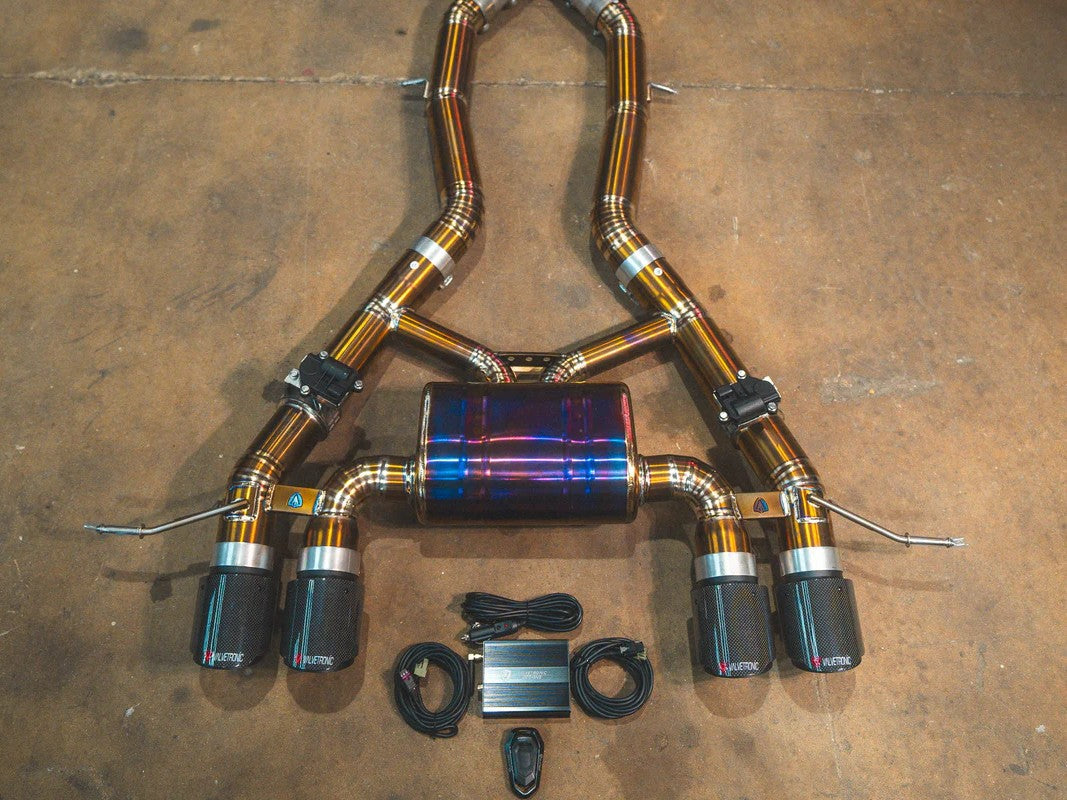
Most factory exhaust systems are a compromise. Engineers have to balance noise regulations, drone at cruising speeds, cold start emissions, and the kind of sound the average buyer expects when they push the start button. The result is usually quiet, restrictive, and a little underwhelming, even on cars that left the factory with proper performance credentials.
A valved exhaust changes that.
How a valved exhaust actually works
A valved exhaust system has one or more butterfly valves built into the rear muffler section. When the valves are closed, exhaust gas is routed through the muffler the way it would be on any standard system. The car is quiet, civilised, and easy to live with.
When the valves open, gas bypasses most of the muffler and exits through a much shorter, less restrictive path. The result is a fuller, deeper exhaust note and a small but real reduction in backpressure.
There are two common ways valves are controlled. Older and more universal systems use a vacuum actuator, which is essentially the same hardware your factory boot release uses. Newer and more sophisticated systems use electronic actuators that integrate directly with the car's existing sport mode button or factory exhaust switch. Brands like Valvetronic Designs have built their reputation on this kind of OEM-style integration, where the aftermarket valve responds to the same input the factory valve would on cars that already came with one.
What you actually get
The headline benefit is range. Closed, a quality valved exhaust can be quieter than stock at idle and at cruise, which matters more than people think when you actually have to commute in the car. Open, it sounds the way the engine probably should have sounded from the factory.
The second benefit is control. Pulling out of a quiet street at 6am should not require permission from the entire neighbourhood. A valved system lets you make that decision yourself.
The third benefit, and the one most buyers underrate until they have it, is the unburdening of throttle response. Factory exhaust systems on cars like the BMW M3, the Toyota Supra, the Porsche 911 and the Audi RS3 are heavily silenced. A free-flowing aftermarket path, particularly one tuned to the engine's specific firing order, can sharpen throttle response measurably.
Will it sound obnoxious
This is the question that stops most buyers from pulling the trigger, and it deserves a direct answer.
A cheap valved exhaust often does sound obnoxious, because the muffler section is too small, the bypass is too aggressive, and there is no resonator tuning. A well-engineered valved exhaust, built around proper Helmholtz resonators and matched to the engine's exhaust signature, does not. It sounds the way the engine wants to sound. On a straight six, it deepens the natural growl. On a turbo four, it does its best to clean up what the turbo wants to mute.
Reputable brands publish decibel readings at idle, at cruise, and under load, both valves open and valves closed. Buy from a brand that publishes those numbers.
What about warranty
In Australia, fitting an aftermarket exhaust does not void your factory warranty. Under the Australian Consumer Law, a manufacturer can only decline a warranty claim if they can prove the aftermarket part caused the failure. A valved cat-back, installed correctly, is downstream of every drivetrain component the manufacturer cares about. It cannot, by definition, damage your engine, gearbox, turbos, or differential.
The exception is if the system requires you to remove or modify factory cats. A cat-delete or cat-bypass is a separate decision with separate consequences. A standard valved cat-back leaves the factory cats and any OPF in place.
Is it legal in Australia
A valved exhaust is legal in Australia provided the system meets the noise limit for your vehicle category in your state. The limits vary, but they are all measured in stationary decibels at a set distance from the exhaust tip. A quality valved system in closed mode is almost always quieter than this limit. In open mode, it depends on the specific car and the specific system.
The practical reality is that a valved exhaust gives you a clean answer to a roadside check. Close the valves, hand the keys over, walk away.
Who actually benefits
A valved exhaust suits a specific kind of buyer. Someone who drives the car often, in environments that vary from quiet residential streets to open road. Someone who values the option to dial the experience up or down. Someone who wants the car to feel different without committing to a permanently loud system that gets old by month three.
If the car only ever leaves the garage on track days, a fixed straight-through system is probably the better answer. For everyone else, a valved exhaust is the most useful exhaust upgrade you can buy in 2026.
The bottom line
A valved exhaust gives you two cars in one. A quiet, civilised cruiser when you need it. A proper performance car when you want it. Done well, it improves the experience of owning the car every single time you drive it. Done badly, it is a fast way to annoy your neighbours and yourself.
The difference is the brand. Buy from a manufacturer that engineers the system for your specific chassis, publishes its specifications, and is supported by an Australian dealer who can stand behind it.
The Vero Motorsport Team
info@veromotorsport.com


