
Body kits are one of those decisions where the wrong call shows up every time someone looks at your car. Get it right and the car looks finished, intentional, custom in a way that reads as quality. Get it wrong and even expensive parts can make a build look thrown together. The question most buyers face is straightforward: do you commit to a complete kit from one brand, or piece it together part by part?
There's a real argument for both. Most buyers will be better off with a complete kit. Some won't. Here's how to know which side you're on.
What we actually mean by "complete kit" and "mixed build"
A complete body kit means the front bumper or front lip, side skirts, rear bumper or rear diffuser, and often a rear wing or trunk spoiler are all designed by the same brand for the same vehicle. Every piece is engineered to flow together visually and physically.
A mixed build takes pieces from different brands or different styling families. A Vorsteiner front lip with Carlsson side skirts and a Brixton rear diffuser is a mixed build, regardless of how good each piece is on its own.
Most aftermarket buyers don't set out to build this way. They start with one piece, then add another six months later from a different brand because the original maker doesn't do the next part, or because they found a better deal, or because their taste shifted. The mixed build outcome happens by accident far more often than by design.
When mixing actually works
There are two scenarios where mixing pieces is the right call.
The first is when you have a specific vision that no single brand executes. If you want a wide-body rear quarter from one manufacturer and a particular front fascia from another because no complete kit captures the look you're chasing, you're not making a buying mistake. You're commissioning a build. Experienced builders end up here regularly, and the result can be excellent if it's planned that way from the start.
The second is when you're doing a subtle OEM+ upgrade. If you're adding just a front lip and a rear lip spoiler, you don't need a "kit." Two well-chosen pieces in similar styling won't create the cohesion problem a full four-piece kit has to solve.
Outside those two cases, mixing usually creates more problems than it solves. The next sections explain why.
Visual cohesion is harder than it looks
A front bumper, side skirts, and rear diffuser have to look like they were designed together because they're going to be photographed together every time someone sees the car. Designers from the same brand work to a consistent set of styling lines, vent shapes, edge angles, and crease patterns. Designers from different brands don't.
The result of mixing isn't usually one obviously broken piece. It's a car where everything looks fine in isolation but doesn't quite work when you step back. The aggressive front bumper sits next to side skirts that are too tame. The race-style rear diffuser argues with a street-style lip spoiler. Each piece is correct on its own. The car as a whole is wrong.
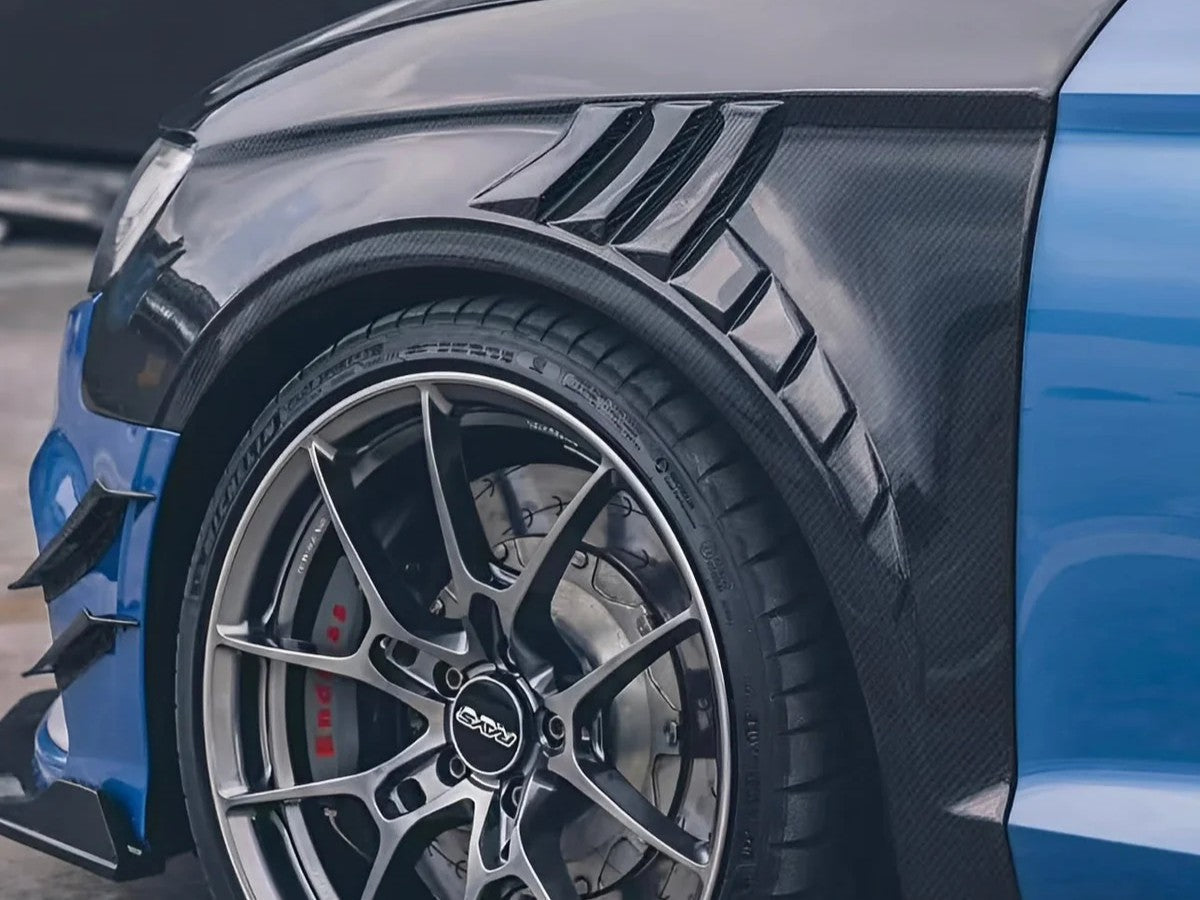
For carbon fibre specifically, this gets worse. Weave patterns vary between manufacturers. One brand's twill weave doesn't match another brand's plain weave. Gloss levels differ. You end up with patches of carbon that don't visually agree, and no amount of polish fixes it.
Fitment is where mixing actually fails
Visual cohesion is the soft problem. Fitment is the hard one.
Aftermarket pieces are designed around a specific reference for how the car sits, what other aftermarket pieces it has, and how the panels align. A front lip from Brand A might sit flush only if Brand A's side skirts continue the line. Pair it with side skirts from Brand B engineered to a slightly different reference and you get a panel gap where the lip and skirt meet.
This is why some workshops refuse to install mixed builds without modification time on the quote. The pieces aren't broken. They just weren't designed to live together.
Mixed builds also tend to have more rattles, more loose attachment points, and more flex over speed bumps because the mounting hardware isn't shared. A kit designed as a unit usually has consistent mounting hardware and bracket placement throughout. A mixed build rarely does.
Where complete kits earn their place
Brands that build complete kits put their reputation on the entire car, not just one part. Armaspeed is a clear example. Their full vehicle-specific kits for Mercedes-AMG, BMW M, and Porsche are engineered as one design language across every piece. Same edge treatment on the front bumper as on the diffuser. Same air-flow logic from the front splitter to the rear. Same carbon weave and finish quality across every panel.
The benefit isn't just visual. It's that you can install the entire kit from one set of instructions, with one set of brackets, one fitment standard, and one warranty point of contact if anything ever goes wrong.
The cost gap is smaller than buyers expect
The instinct to mix is often financial. Buy one piece this month, save up for the next. By the time the build is complete, you've often spent more than a complete kit would have cost, plus modification labour to make mismatched pieces sit right.
Complete kits are usually priced below the equivalent piece-by-piece cost from the same brand. They cost less because the brand wants you to buy the whole car's look from them, not just one piece.
Where mixed builds end up more expensive: the painter charges more for matching finishes across different weaves, the installer charges more for shimming or trimming pieces to fit, and the resale buyer either pays less because the parts don't match or asks for the kit to be removed before purchase.
Bottom line
If you have a specific vision that requires pieces from different brands and you're prepared for the fitment and finish work that comes with it, a mixed build can be the right call. Plan for it as a commissioned project, not a budget option.
If you're not in that specific situation, a complete kit will give you a better-looking car for less total cost and a smoother install. Pick a brand whose styling language matches what you want, then commit to the full kit they designed for your car.
Either way, the decision is worth making upfront rather than ending up with a mixed build by accident over twelve months of small purchases.
The Vero Motorsport Team
info@veromotorsport.com


