
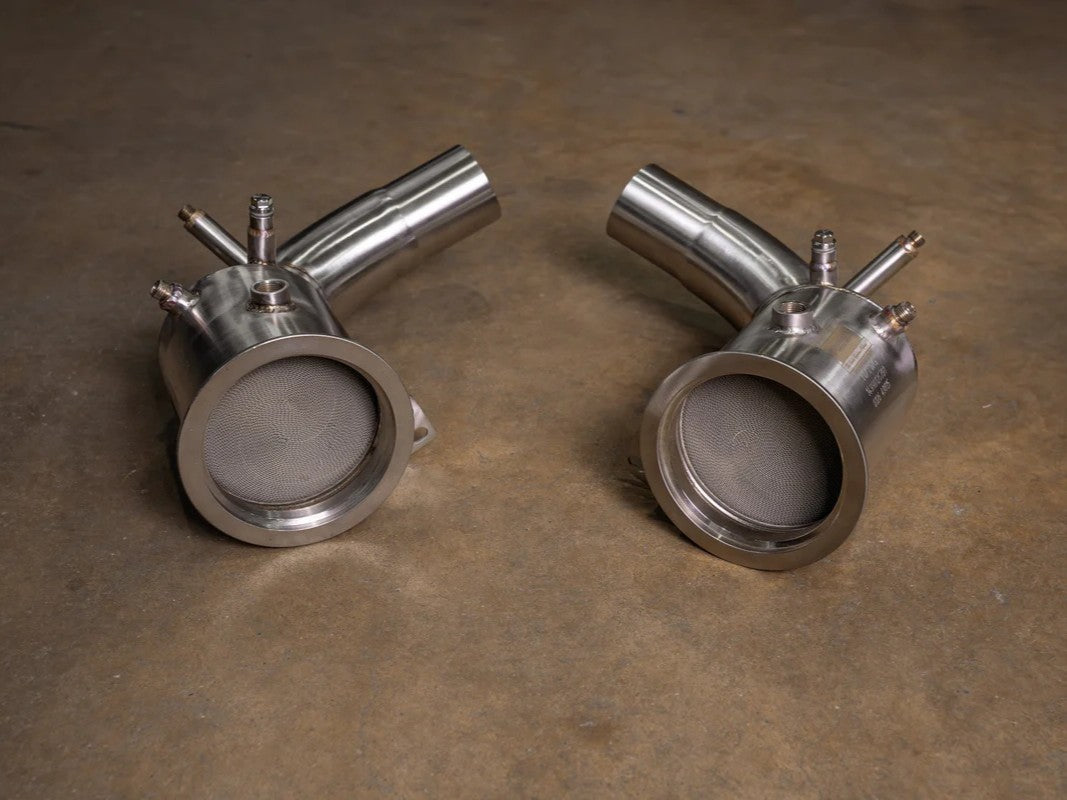
One of the most common questions we get before someone buys a downpipe is whether it will trigger a check engine light. The honest answer is that it can, particularly on a catless or high-flow setup, and the reason has nothing to do with the part being faulty. Understanding why the light comes on makes the fix obvious, and it is not the cheap workaround most forums will point you toward.
Why a downpipe can trigger a check engine light
Your car monitors the catalytic converter using a second oxygen sensor positioned after it. The factory cat scrubs the exhaust gas, so the readings before and after the cat are different. The ECU expects to see that difference. It is how the car confirms the cat is doing its job.
When you fit a high-flow or catless downpipe, that rear oxygen sensor no longer sees a properly working cat in front of it. The readings before and after look too similar, the ECU concludes the cat has failed, and it stores a catalytic converter efficiency fault. That is the P0420 or P0430 code most people see, and it brings on the check engine light.
Catted, high-flow, and catless
The likelihood of a light depends on the type of downpipe. A catless downpipe has no cat at all, so it will almost always trigger a light without further work. A high-flow catted downpipe keeps a less restrictive sports cat, which often satisfies the sensor and avoids a light on many cars, though not all. A factory replacement catted downpipe is the least likely to cause any issue.
This is one of the trade-offs to weigh when choosing between them. A high-flow catted option frequently runs clean with no fault, while a catless option almost always needs the fault addressed properly.
The right way to fix it
The correct fix is a tune. When a downpipe is fitted, the car should be tuned with the rear oxygen sensor monitoring disabled, or the cat efficiency check recalibrated, so the ECU stops looking for a cat that is no longer there. A proper tune does this cleanly and permanently. The light goes off and stays off, and the tune also lets you extract the actual power the downpipe unlocked.
This is why a downpipe and a tune are almost always sold and fitted together. The downpipe improves flow, and the tune both clears the fault and realises the gains. Fitting a downpipe without a tune leaves power on the table and, on a catless setup, leaves the light on.
The fixes to avoid
You will see cheap workarounds advertised, such as oxygen sensor spacers, spark plug non-foulers used as spacers, and oxygen sensor simulators. These move the sensor away from the gas flow or fake a signal to trick the ECU. They sometimes work, but they are a band-aid, not a fix. They can throw new faults, behave inconsistently across cars, and do nothing for the tuning side of the equation.
If you are spending money on a quality downpipe, spend the rest on a proper tune rather than a plastic spacer. It is the difference between a car that runs correctly and a car with a hidden problem masked.
A note on compliance in Australia
Removing or gutting the catalytic converter is not road legal in Australia and affects your emissions compliance. Catless downpipes are sold for off-road and track use. If your car is a daily driver that needs to remain road legal, a high-flow catted downpipe is the appropriate choice, as it retains a working cat while still improving flow. Always match the part to how the car is actually used and check your state emissions requirements before deciding.
The bottom line
A downpipe can trigger a check engine light because the car no longer detects a fully working cat behind it. The fix is a proper tune, not a sensor spacer. If road legality matters, choose a high-flow catted downpipe and have it tuned. If the car is track only, a catless downpipe tuned correctly will run clean and make the most power.
The Vero Motorsport Team
info@veromotorsport.com


