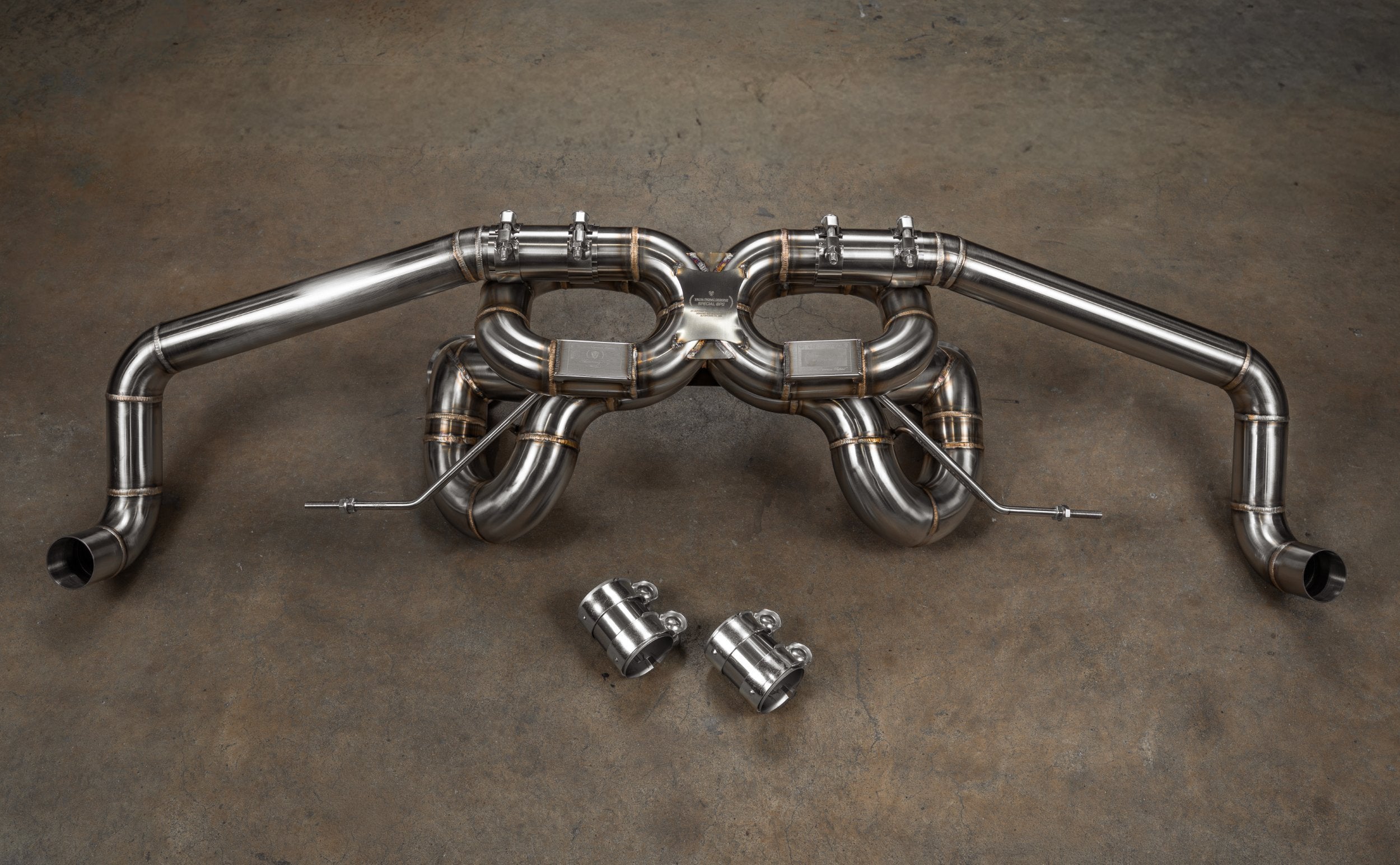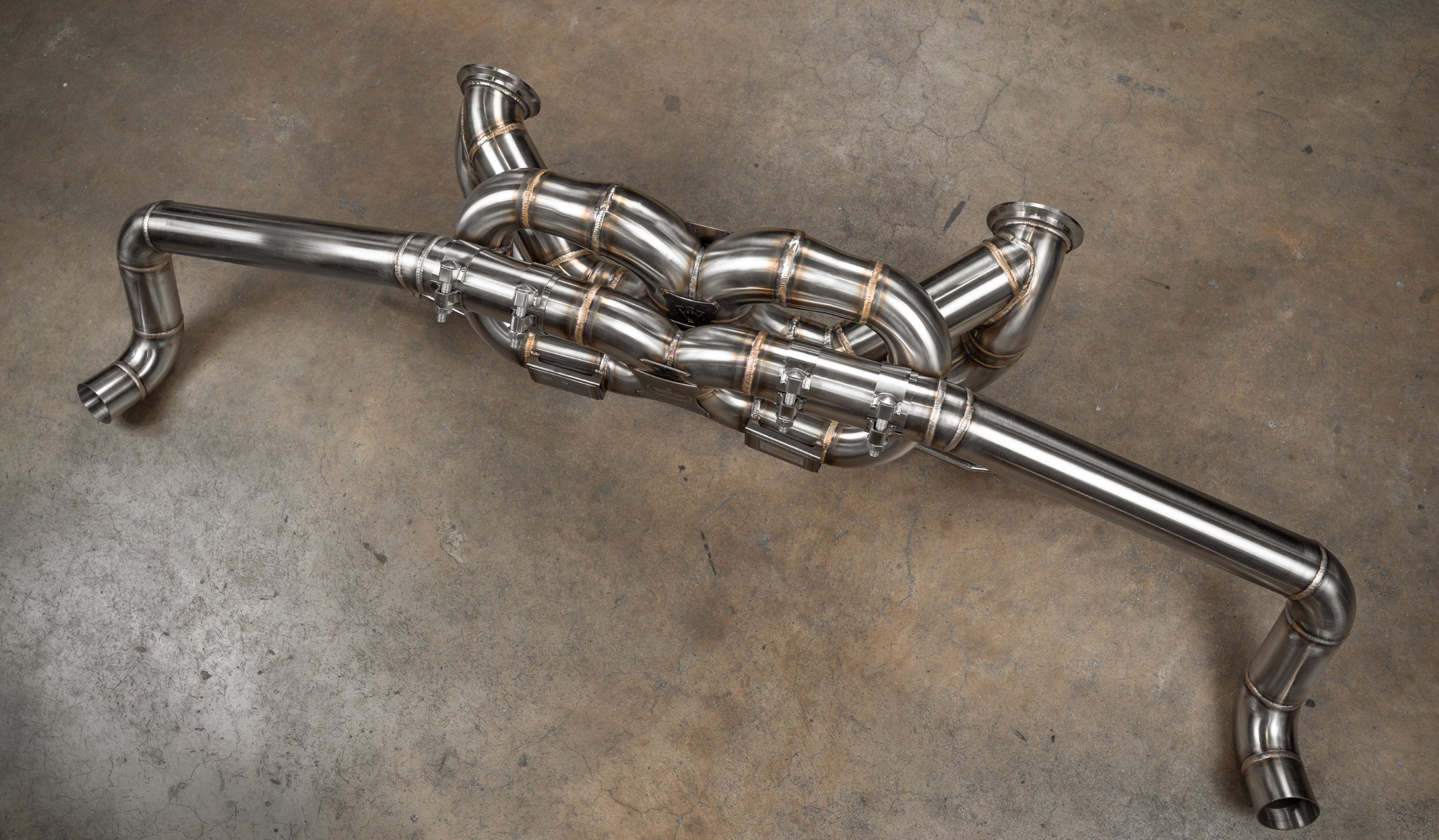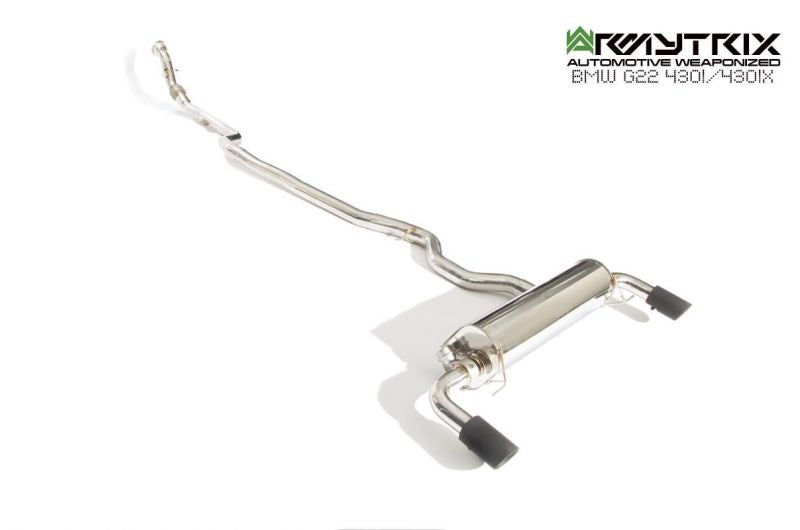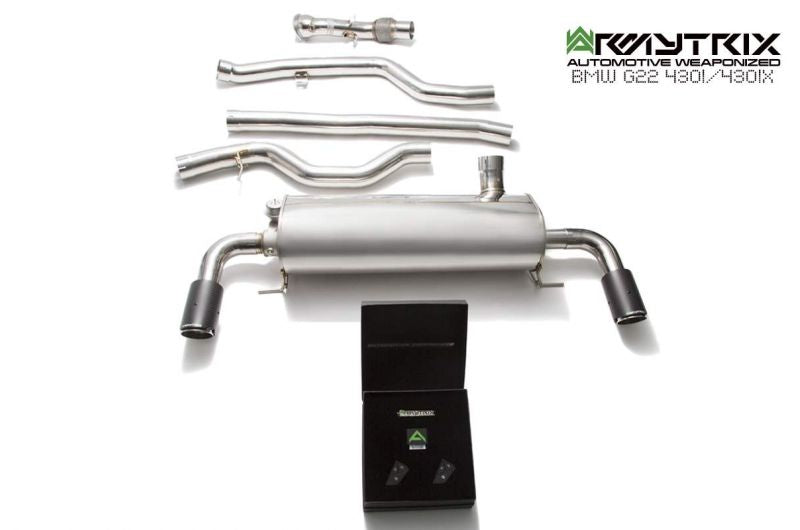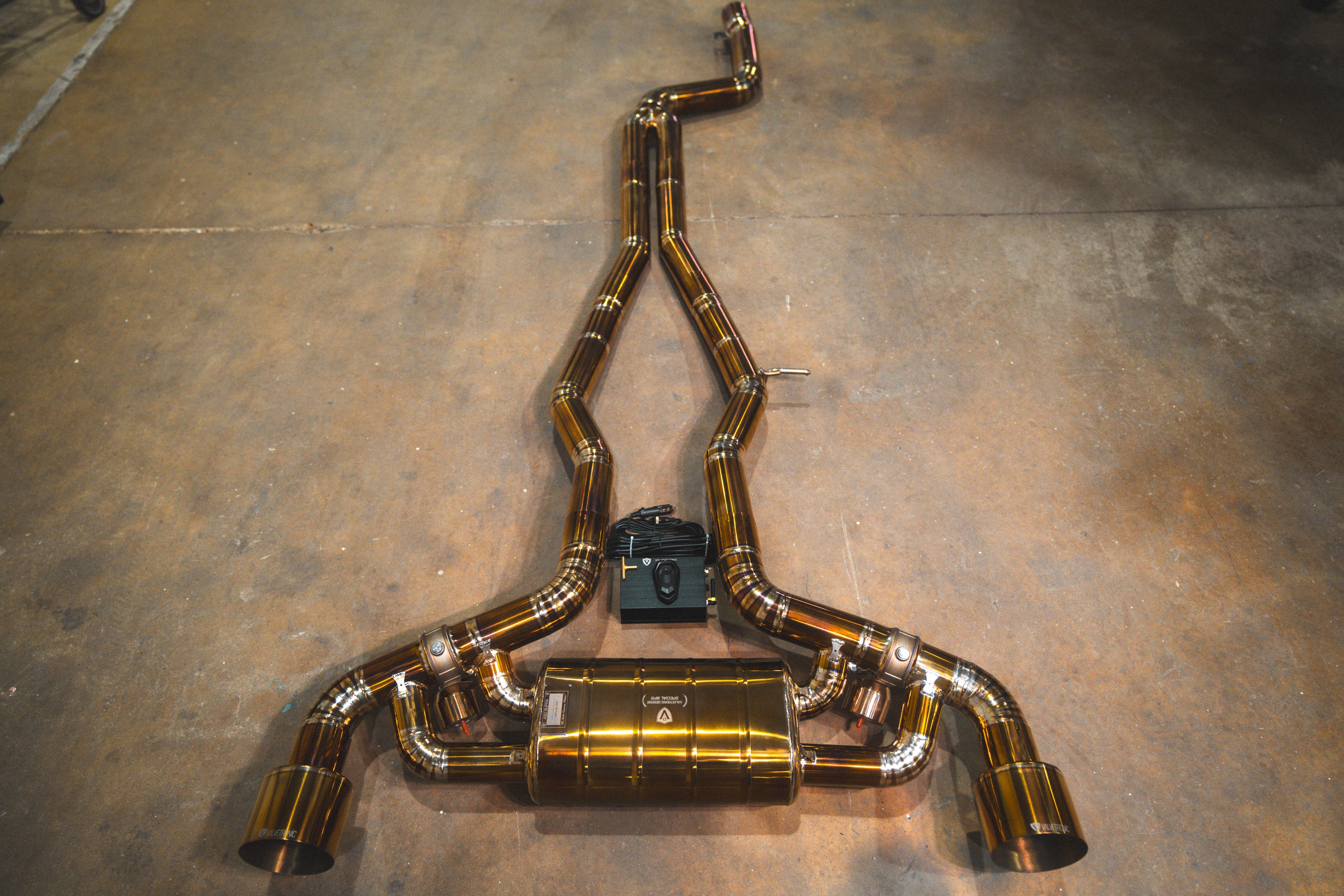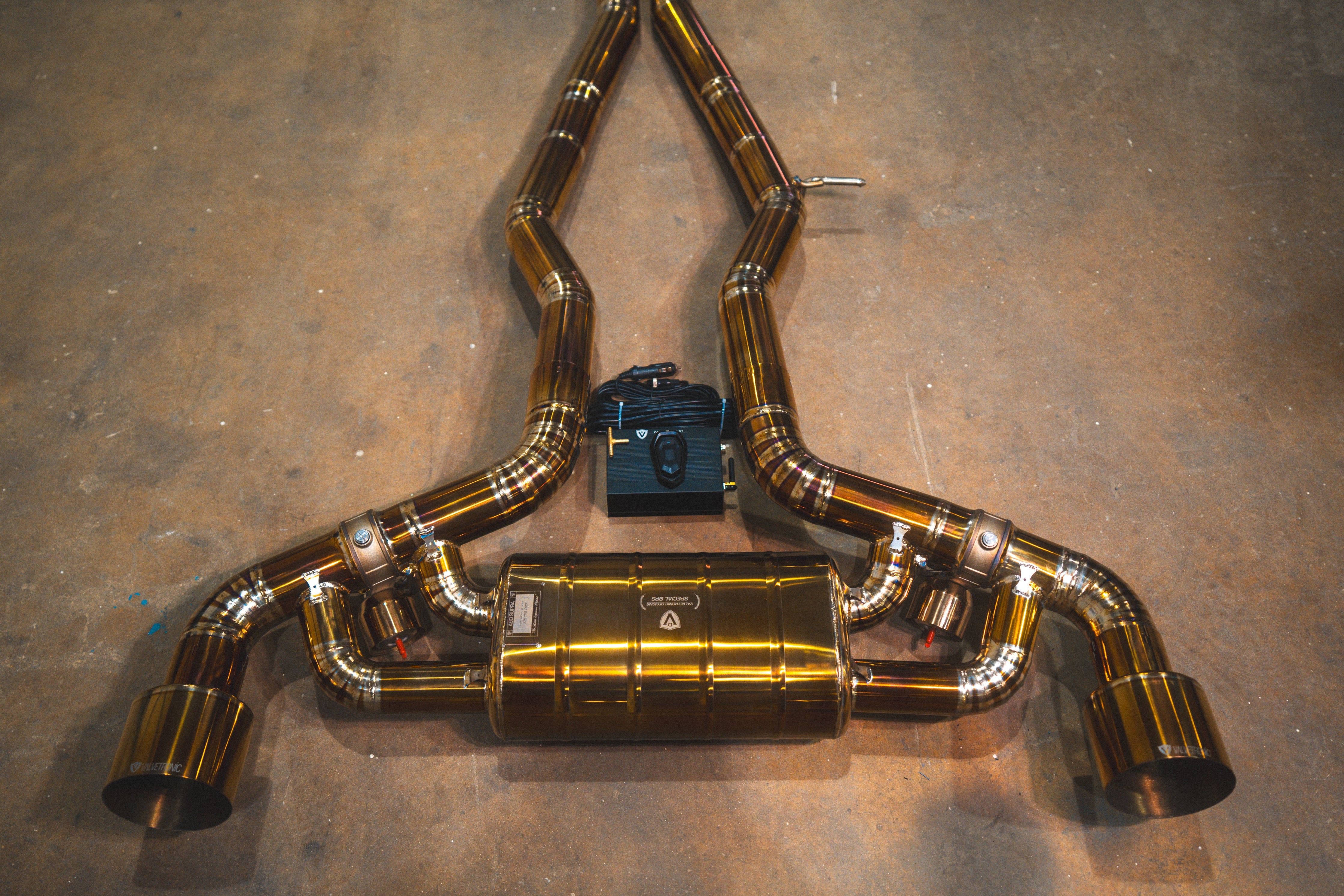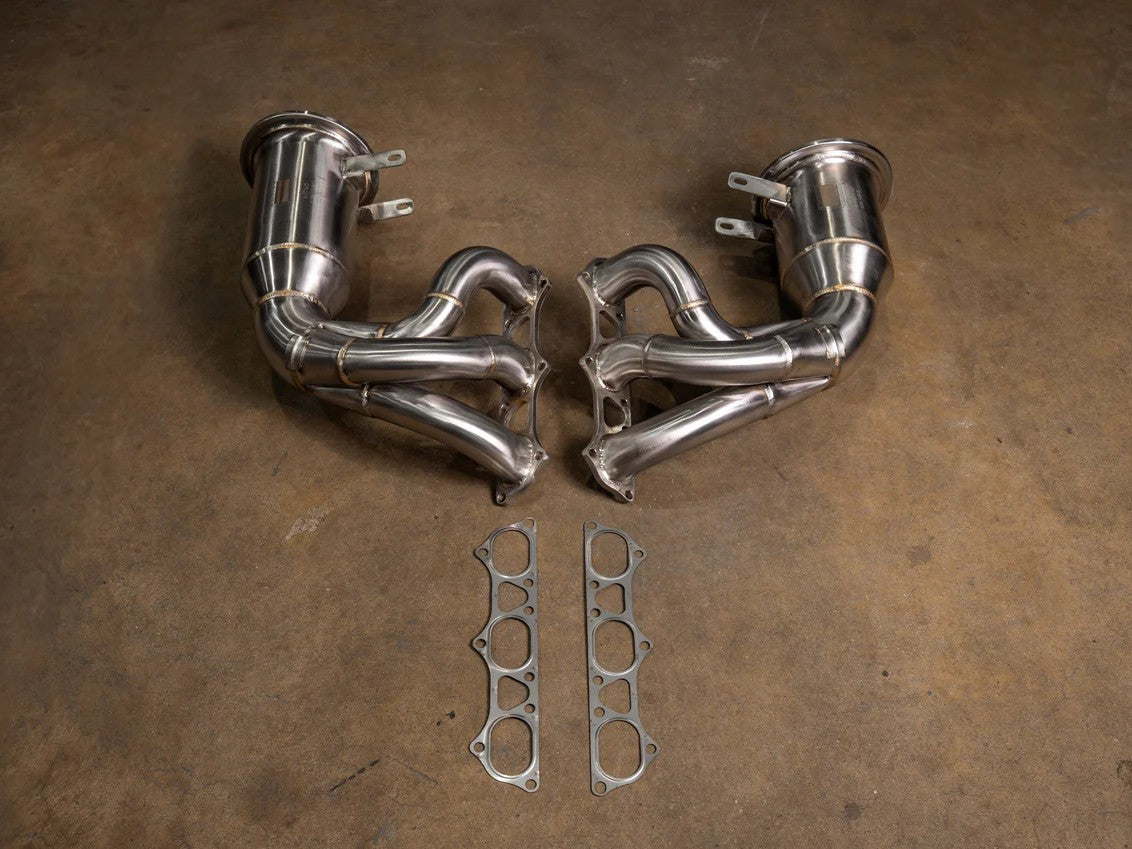
This is one of the most common questions we get from customers chasing a meaningful exhaust upgrade, and it is almost always asked in the wrong order. People ask which is better. The more useful question is which is right for the way you actually use the car.
Both have real strengths. Both have real costs. Here is what each one is, what it gives you, and how to decide.
First, what a downpipe actually is
On a turbocharged car, the downpipe is the section of exhaust that bolts directly to the turbo's outlet. It is the first place exhaust gas travels after leaving the turbine wheel, and it sets the rules for everything downstream. A restrictive downpipe slows everything down. An open one lets the turbo breathe.
The downpipe is also where the factory catalytic converters live on most modern performance cars, including the BMW S58, S55 and B58, the Audi 2.5 TFSI, the Toyota A90 Supra's B58, and the Mercedes M139.
Two versions hit the market for almost every popular platform. A catted version retains a catalytic converter, usually a higher-flowing aftermarket cat with a lower cell count. A catless version, also called a decat or test pipe, removes the cat entirely.
What a catted downpipe gives you
A high-flow catted downpipe replaces the restrictive factory cat with a 200-cell or 300-cell aftermarket unit. The cell count refers to how many channels per square inch the cat substrate has. The factory item is typically 400-cell or higher, which is great for emissions and bad for flow.
The benefits are real. On a tuned BMW S58, a quality 200-cell catted downpipe is generally worth 30 to 40 horsepower at the wheels with a supporting tune, plus a sharper throttle response and faster turbo spool. The car feels noticeably more eager from 3,000rpm and pulls harder to redline.
The catalytic converter is still doing its job, which means three things. Emissions stay within reasonable limits. The check engine light stays off without any need to flash out the rear oxygen sensors. The car still smells like a normal car when you drive it.
What a catless downpipe gives you
A catless downpipe is exactly what the name describes. No catalytic converter at all. Just a clean, smooth, large-diameter pipe from the turbo to the rest of the exhaust.
The performance gain over a catted downpipe is small but measurable. On the same BMW S58, a catless downpipe is usually worth an additional 10 to 15 horsepower at the wheels over a 200-cell catted version. Turbo spool is also marginally faster, in the order of 100 to 200rpm earlier.
The other effects are larger. The exhaust note becomes noticeably more aggressive, particularly on cold start and in the upper rev range. The car emits raw exhaust gas, which means a stronger smell and significantly higher emissions. The factory rear oxygen sensors will throw codes unless the tune is set up to ignore them.
The performance difference is smaller than people think
This is the part of the conversation that gets distorted in forum threads. Most modern factory cats have improved enormously over the last decade. The gap between a quality catted downpipe and a catless one is real, but it is not the difference between a slow car and a fast one. It is usually 10 to 15 horsepower on a 600 horsepower car. On a dyno graph, it is clearly visible. From the driver's seat, it is subtle.
The bigger gain, by a significant margin, comes from removing the factory cats in the first place. That is true whether you replace them with high-flow units or with empty pipes.
Sound
A catless downpipe is louder. Specifically, it is louder in the low and mid range, where the cat would otherwise absorb a portion of the exhaust note. Cold starts are dramatically more aggressive. Idle is deeper. Off-throttle transitions can produce more pronounced crackle and pop on cars that already have an aftermarket tune mapped for it.
A catted downpipe is quieter than catless, but still louder than stock. The character changes more than the volume. The cat absorbs less of the original engine signature, so the exhaust note becomes deeper and more authentic to the engine.
Smell and drone
Catless downpipes smell. There is no way around it. The raw exhaust gas that leaves a turbo before catalytic conversion contains hydrocarbons and other compounds that the cat is designed to break down. Without a cat, you smell them. In stop-start traffic, in tunnels, in your own garage when you start the car, the difference is obvious.
The smell also tends to drift into the cabin, particularly on cars where the boot or HVAC system can pull air from underneath. This is the single most common complaint from buyers who go catless and later regret it.
Drone is a separate question and depends more on the rest of the exhaust system than on the downpipe itself. A well-designed cat-back with proper resonators will manage drone whether the downpipe is catted or catless.
Legality in Australia
This is the part that matters most for most buyers. In Australia, removing or disabling a catalytic converter on a road-registered vehicle is illegal under state environmental and vehicle standards regulations. It does not matter whether the car passes a noise test. The absence of a cat alone is grounds for a defect notice in every state.
A high-flow catted downpipe is a grey area. The car still has a catalytic converter. It is not the original part, and emissions are not identical to factory, but the legal position is significantly stronger than catless.
For track use only, a catless downpipe is fine. For a street-driven car that you want to keep on the road without engineering hassles, a catted downpipe is the right choice.
Warranty
Both modifications affect warranty for any component downstream of the turbo. In practice, dealers are far more likely to push back on warranty claims for cars that arrive on a service tray with no catalytic converters bolted in. A catted downpipe is harder to flag at a glance.
Under the Australian Consumer Law, the manufacturer still needs to prove that the modification caused the failure. A downpipe, catted or catless, has nothing to do with a failed window regulator or a faulty infotainment screen. But it can absolutely be linked to drivetrain failures if the car has also been tuned for more boost than the factory components were designed for.
So which one should you get
If the car is street-driven and registered, the answer is almost always a high-flow catted downpipe. You get most of the performance, almost all of the sound character, none of the smell, and a defensible legal position.
If the car is a dedicated track or motorsport build that does not need to pass roadside compliance, a catless downpipe is the cleaner choice. It is lighter, simpler, slightly faster, and the smell does not matter on a circuit.
If you are not sure which category you fall into, you are a street driver. Get the catted version. The 10 to 15 horsepower difference is not worth the headaches.
The bottom line
The catted versus catless decision is less about performance and more about use case. Both work. Both are real upgrades. The right choice is the one that matches how the car actually lives.
If you want to talk through which option suits your specific build, send us an email or browse the exhaust range online.
The Vero Motorsport Team
info@veromotorsport.com